
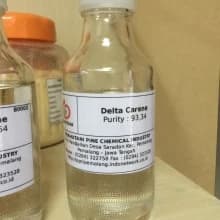
Delta Carene (99,5%) - China
- IUPAC Name
- 4,7,7-trimethylbicyclo[4.1.0]hept-2-ene
- Molecular Formula
- C10H16
- Molecular Weight (g/mol)
- 136.2300
- Synonyms & Trade Names
- Delta-3-carene; 3-Carene; Delta carene; (+)-3-Carene
- Purity / Assay (%)
- 99.5% min
- Grade / Quality Level
- Technical Grade
Technical Document
Download MSDSBrief Overview:
Rosin esters are often used as tackifiers. They are a main component during formulating of aqueous and solvent-based adhesives, particularly flooring adhesives. Low-VOC versions (EC1-norm) are also available. Linear rosin esters not only provide adhesion but also flexibility for the systems. Esters of rosin, commonly known as ester gums, are highly versatile resins used in adhesives, coatings, inks, and other markets. Their unique functionality has led to specialized food applications in beverages and chewing gum.
Manufacturing Process:
Equipped with a stirrer, temperature controller, and sample tube with a diameter of 5 mm. A steel filter with a bore diameter less than 10 μm was installed on the bottom of the sample tube to filter the catalyst powders. Even though rosin was diluted by Oil #200, the mixed solution still had high viscosity and tended to be coagulated at low temperature. In addition, all the reactions were performed under high H2 pressure, which made the sampling operation difficult and dangerous. To keep the rosin solution flow and sample tube clean, the sample tube was covered by electrical heating belts and connected to the hydrogen tube. For security, all the three-way valves in the heating zone were closed. When sampling, the three-way valves of the sample tube were opened, the solution sample was withdrawn, and then the valves were closed. Certain amounts of rosin (ground to a size of 10 mm), Oil #200, and LDH-Ni/Scat were added to the reactor. The catalyst dosage was 5 wt%. The reactor was closed and connected to a vacuum system to remove the air. N2 gas was charged into the reactor to a pressure of 0.5 MPa, which was maintained for several minutes to check its gas-tightness. Then N2 gas was replaced by H2 gas. The stirrer and temperature controller were turned on. Once the temperature reached the desired value, the stirring rate and H2 pressure were increased to initiate the hydrogenation reactions. The present investigation was carried out at temperatures of 423, 433, 443, and 453 K under an H2 pressure of 5 MPa.