
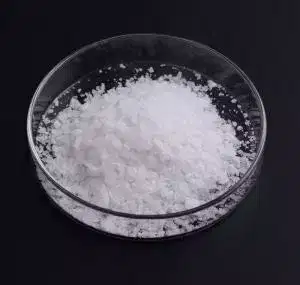
Phthalic Anhydride (99,8%) - Taiwan
- IUPAC Name
- 2-benzofuran-1,3-dione
- Molecular Formula
- C8H4O3
- Molecular Weight (g/mol)
- 148.1200
- Synonyms & Trade Names
- Phthalic anhydride; PA; Isobenzofuran-1,3-dione; 1,3-Isobenzofurandione
- Purity / Assay (%)
- 99.5% min
- Grade / Quality Level
- Industrial Grade
Categories
Technical Document
Description:
Phthalic anhydride is the organic compound with the formula C6H4(CO)2O, , serves as the anhydride of phthalic acid and represents a crucial commercial form of the acid. It stands as a pioneering example of the widespread utilization of a dicarboxylic acid anhydride, playing a vital role in industrial chemistry. Specifically, it plays a key role in the extensive production of plasticizers for plastics, contributing to the estimated global production volume of around 3 million tonnes annually in 2000.
Manufacturing Process:
Discovered by Auguste Laurent in 1836, the contemporary synthesis of phthalic anhydride employs various methods, including the oxidation of naphthalene or ortho-xylene. These processes incorporate vanadium pentoxide (V2O5) as the active oxidant, playing a pivotal role in multiple steps and being regenerated by molecular oxygen. Starting from o-xylene, the oxidation reaction is run at about 320–400 °C and has the following stoichiometry:
C6H4(CH3)2 + 3 O2 → C6H4(CO)2O + 3 H2O
The reaction proceeds with about 70% selectivity. About 10% of maleic anhydride is also produced: C6H4(CH3)2 + 7.5 O2 → C4H2O3 +4 H2O + 4 CO2
Phthalic anhydride and maleic anhydride are recovered by distillation by a series of switch condensers.
The naphthalene route (the Gibbs phthalic anhydride process or the Gibbs–Wohg naphthalene oxidation reaction), a process whose use has declined in compared to the o-xylene route, has the following mechanism:
Phthalic anhydride can also be prepared from phthalic acid by simple dehydration.