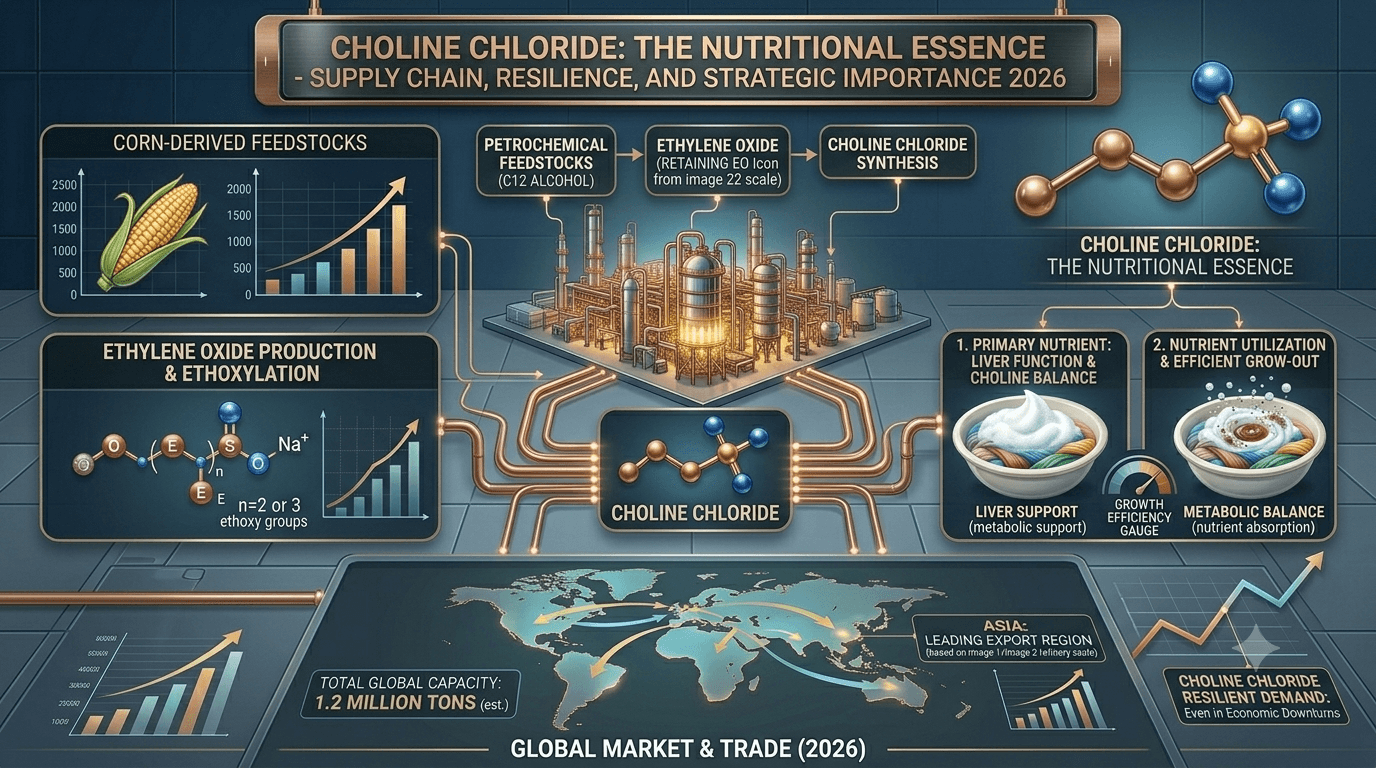
Choline Chloride: The Feed Additive Linked to Corn, Ethylene Oxide and Animal Nutrition
Overview
Choline chloride is a water-soluble essential nutrient widely used in animal feed formulations. Classified as a B-complex vitamin-like compound, it plays a crucial role in metabolism, liver function, and fat transport in poultry, swine, fish, and pet nutrition. Because animals cannot synthesize sufficient choline on their own, supplementation is required in modern commercial feed systems.
Its importance has grown significantly alongside the expansion of intensive livestock and aquaculture production worldwide.

What Is Choline Chloride?
Choline chloride is an organic compound that functions as a key nutritional additive in feed. It supports:
Fat metabolism and liver health
Cell membrane structure
Nervous system function
Growth performance in livestock
Egg production in poultry
It is typically added to feed premixes rather than being used directly in raw feeding formulations.
Choline Chloride 75% Liquid CAS: 67-48-1
Production Process
Choline chloride is produced through a chemical synthesis route involving:
Ethylene oxide
Trimethylamine (TMA)
Hydrochloric acid (HCl)
The general reaction pathway is:
Ethylene Oxide + Trimethylamine + HCl → Choline Chloride
Because ethylene oxide is a critical intermediate, the production cost and availability of choline chloride are closely tied to the global ethylene value chain.

Link to Ethylene and Middle East Supply Disruption
In 2026, disruptions in Middle Eastern petrochemical supply chains significantly affected ethylene and ethylene oxide availability.
Key impacts included:
Tightening of ethylene oxide supply
Higher raw material costs for feed additives
Increased freight and insurance premiums
Temporary supply delays across Asia
Volatility in downstream feed additive pricing
Since ethylene oxide is derived from ethylene (a key petrochemical), any disruption in upstream energy or refining systems quickly affects choline chloride economics.
China’s Dominant Position
China is the global leader in choline chloride production, accounting for a majority of both liquid and carrier-based grades.
Key strengths include:
Integrated petrochemical infrastructure
Large-scale ethylene oxide production
Cost-efficient manufacturing base
Strong export networks
China supplies a major share of global demand across Asia, Latin America, Africa, and parts of Europe.
Major Product Forms
Choline chloride is mainly traded in two commercial forms:
Choline Chloride 60% (Corn Cob Carrier)
Solid powder form
Choline chloride absorbed onto corn cob or silica carrier
Easy handling and blending in premixes
Widely used in poultry and swine feed
Choline Chloride 75% Liquid
Concentrated aqueous solution
Used in liquid feed additives and industrial blending
Requires careful storage and transport
Popular in large-scale feed manufacturing systems
Both grades are actively traded on global B2B chemical platforms based on specification, carrier type, and purity levels.
Key Application Areas
Choline chloride is used across multiple animal nutrition sectors:
Poultry feed (largest segment)
Swine nutrition
Aquaculture (fish and shrimp feed)
Pet food formulations
Vitamin premixes and feed additives
Poultry remains the dominant consumption sector due to global demand for affordable protein.
Demand Drivers
Global demand for choline chloride is being driven by:
Expansion of commercial poultry farming
Rising aquaculture production
Increasing meat consumption in developing regions
Growth of integrated feed manufacturing systems
Focus on feed efficiency and animal health
Asia, Latin America, and Africa are the fastest-growing consumption regions.
Market Structure and Trade
The choline chloride market is highly export-oriented, with China as the central supply hub. International trade is structured around:
Bulk industrial buyers (feed mills)
Premix manufacturers
Distributors and traders
B2B chemical marketplaces
Pricing is sensitive to raw material costs, especially ethylene oxide, methanol derivatives, and energy inputs.
Market Outlook
The choline chloride market in 2026 is shaped by the interaction between petrochemical volatility and strong agricultural demand. While supply disruptions in ethylene oxide and logistics constraints may cause short-term price fluctuations, long-term growth remains supported by expanding livestock production and aquaculture industries worldwide.
Key Takeaways
Choline chloride is an essential feed additive used in poultry, swine, fish, and pet nutrition.
It is produced from ethylene oxide, trimethylamine, and hydrochloric acid.
Ethylene supply disruptions in 2026 increased production cost sensitivity.
China dominates global production and exports.
Main commercial forms are 60% corn cob carrier and 75% liquid grades.
Poultry farming is the largest end-use segment.
Strong demand growth is driven by Asia, Africa, and Latin America.