
Introduction
Environmental performance has become a defining factor in modern industrial operations. As manufacturers, utilities, and processors face increasing pressure to reduce emissions, improve safety, and comply with stricter regulations, the choice of basic process chemicals now carries long-term sustainability implications. Among commonly used alkaline chemicals, soda ash dense has gained recognition for supporting environmentally responsible operations across multiple industries.
Soda ash dense, widely applied in water treatment, manufacturing, and pollution control, offers a balance between effective alkalinity and lower environmental burden. Compared with more aggressive alkalis, it supports efficient pH control, reduces operational risks, and contributes to lower lifecycle emissions. This article explores the environmental benefits of soda ash dense, focusing on its production profile, application advantages, and contribution to sustainable industrial practices. For companies seeking reliable and responsible sourcing, Chemtradeasia plays a key role in connecting buyers with consistent, high-quality soda ash dense supplies.
Soda Ash Dense and Its Sustainability Profile
Soda ash dense is the high-density granular form of sodium carbonate with a chemical formula of Na2CO3. It is produced either by refining soda ash light or by processing natural trona ore. The resulting product has a bulk density of roughly 0.9 to 1.1 g/cm³, allowing efficient storage, reduced dust generation, and smoother handling in large-scale operations.
From a sustainability perspective, soda ash production benefits from relatively efficient manufacturing pathways. The Solvay process, which dominates synthetic soda ash production, operates as a closed-loop system that recovers and reuses ammonia, limiting waste generation. Natural soda ash sourced from trona mining further reduces environmental impact by avoiding several energy-intensive reaction steps, resulting in a lower overall carbon footprint.
Chemically, soda ash dense delivers moderate alkalinity with solution pH values around 11.5. This level is sufficient for pH control, buffering, and precipitation reactions without the extreme reactivity associated with stronger alkalis. Its stable and non-flammable nature simplifies storage and handling, contributing to safer workplaces and reduced environmental risk.
Reduced Environmental Impact Compared with Other Alkalis
When evaluated against common alternatives such as caustic soda and lime, soda ash dense demonstrates several environmental and operational advantages.
Caustic soda operates at very high alkalinity levels and poses significant safety risks during handling and dilution. Severe chemical burns, corrosion of equipment, and heat release during dissolution increase both occupational hazards and environmental exposure potential. Soda ash dense dissolves without generating excessive heat and presents a much lower risk profile, reducing the likelihood of accidents and chemical releases.
Lime-based systems introduce challenges related to sludge generation, scaling, and higher maintenance requirements. Lime often requires additional equipment for slaking and handling, increasing energy use and waste output. Soda ash dense produces fewer secondary solids in many applications and integrates more easily into existing treatment systems.
Logistics also play a role in environmental performance. Soda ash dense is transported as a dry solid, unlike liquid caustic soda solutions that include a large proportion of water. Transporting less inactive mass reduces fuel consumption and associated emissions across the supply chain, improving overall carbon efficiency.
Environmental Benefits in Water and Wastewater Treatment
Water and wastewater treatment represents one of the most important areas where soda ash dense supports environmental protection.
pH Stabilization and Infrastructure Protection
Maintaining stable pH is essential for protecting pipelines, storage tanks, and distribution networks. Acidic water accelerates corrosion and increases the risk of metal leaching into treated water. Soda ash dense raises and stabilizes pH through carbonate buffering, helping maintain water within an optimal range for both infrastructure protection and ecological balance.
Unlike stronger bases, soda ash provides gradual and controlled pH adjustment. This reduces the risk of overdosing and minimizes stress on downstream biological treatment systems, supporting consistent treatment performance.
Heavy Metal Removal
Many industrial and municipal wastewaters contain dissolved metals such as iron, copper, zinc, and manganese. At higher pH levels, these metals form insoluble compounds that can be removed through sedimentation and filtration. Soda ash dense supports this process by increasing alkalinity and supplying carbonate ions that aid precipitation.
Effective metal removal protects receiving water bodies and helps facilities comply with increasingly strict discharge regulations. The resulting solids are generally stable and easier to manage compared with some alternative treatment byproducts.
Hardness Reduction and Water Reuse
Soda ash dense reacts with calcium and magnesium to form insoluble carbonates, reducing water hardness and preventing scale formation. Scale control improves heat transfer efficiency, lowers energy consumption, and extends equipment life. These improvements enable higher water reuse rates and reduce overall freshwater demand, contributing directly to conservation goals.
Facilities that adopt soda ash-based softening often report measurable reductions in operating costs alongside improved water quality consistency, reinforcing the link between environmental and economic performance.
Contribution to Air Pollution Control
Beyond water treatment, soda ash dense plays an important role in air emission control, particularly in flue gas desulfurization systems. Sulfur dioxide emissions from combustion processes contribute to acid rain and respiratory health issues.
In dry and semi-dry desulfurization systems, soda ash reacts with sulfur dioxide to form stable sodium sulfite and sulfate compounds. These solids are captured by dust collection equipment, achieving high removal efficiency without generating liquid waste streams. Compared with lime-based systems, soda ash offers faster reaction kinetics and a smaller equipment footprint, which reduces material use and simplifies waste handling.
This dry process approach aligns well with facilities facing water scarcity or limited space, further strengthening soda ash dense as an environmentally adaptable solution.
Supporting Sustainable Manufacturing and Circular Systems
Soda ash dense contributes to sustainability across several manufacturing sectors. In glass production, it lowers the melting temperature of silica, reducing furnace energy consumption and associated emissions. Since glass is highly recyclable, soda ash indirectly supports circular material flows and lower lifecycle impacts for packaging and construction products.
In pulp and paper manufacturing, soda ash supports chemical recovery systems and process optimization, enabling reduced water usage and improved efficiency. In chemical synthesis, it serves as a precursor for products such as sodium silicates and bicarbonates, allowing efficient reactions with limited waste generation.
Ongoing research continues to explore soda ash applications in carbon capture and utilization technologies, highlighting its potential role in future decarbonization strategies.
Regulatory Acceptance and ESG Alignment
Soda ash dense is widely accepted by environmental regulators for use in water treatment, air pollution control, and industrial processing. Its long history of safe application simplifies permitting and regulatory approval compared with more hazardous chemicals.
Producers increasingly provide environmental product declarations that detail lifecycle emissions and resource use. These disclosures support transparent reporting under ESG frameworks and help downstream users assess Scope 3 emissions. Natural soda ash producers, in particular, have achieved significant emission reductions through renewable energy use and efficiency improvements, enhancing the sustainability profile of the overall supply chain.
Conclusion
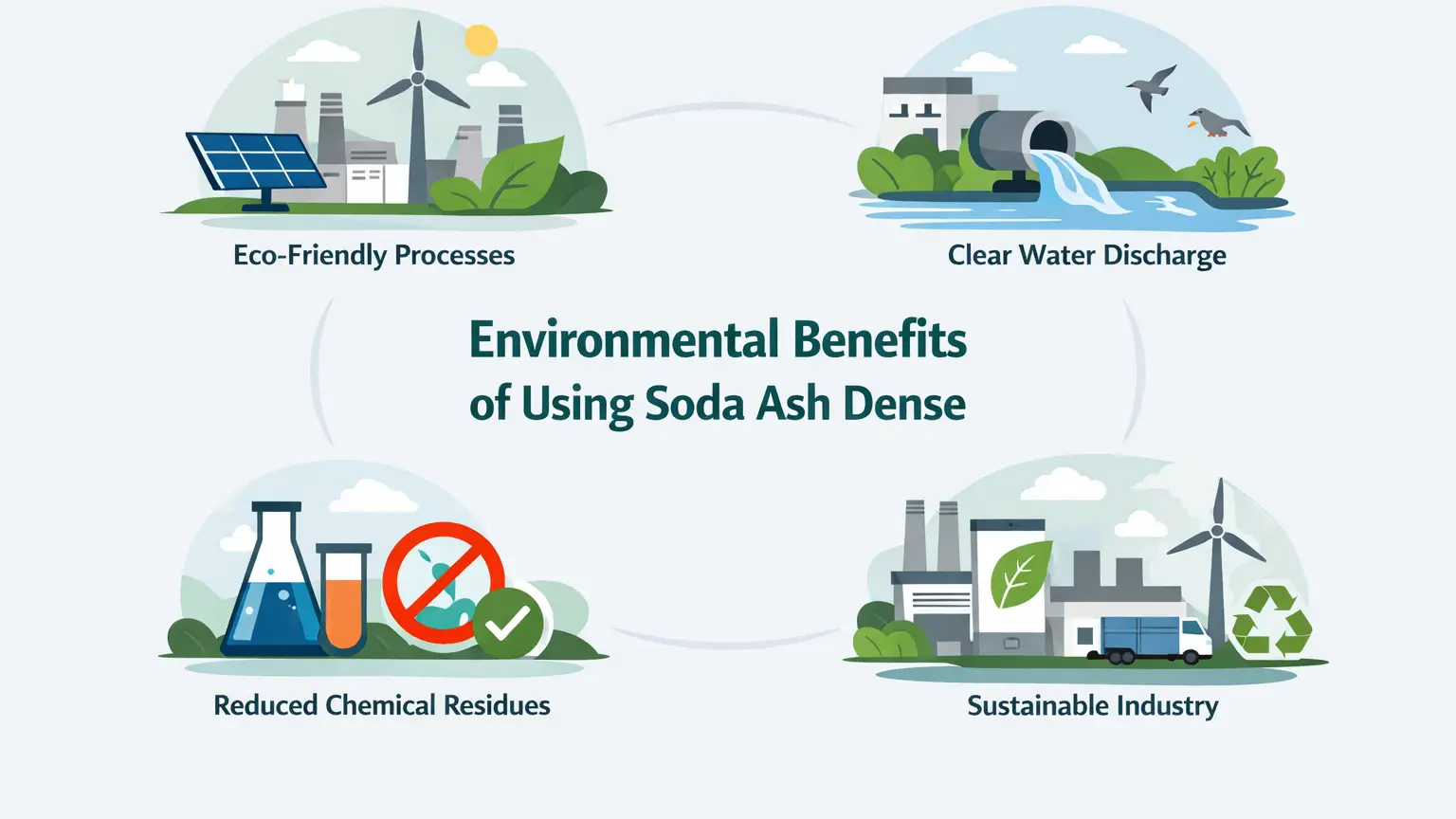
The environmental benefits of using soda ash dense extend across water protection, air quality improvement, manufacturing efficiency, and workplace safety. Its moderate alkalinity, lower carbon intensity, and manageable handling requirements make it a practical alternative to more aggressive alkaline chemicals.
As industries move toward integrated sustainability strategies, soda ash dense offers a proven way to improve environmental performance without compromising operational reliability or cost efficiency. Partnering with experienced suppliers such as Chemtradeasia ensures access to consistent-quality soda ash dense, reliable logistics, and technical support tailored to environmental and operational needs.
By choosing soda ash dense from trusted sources, organizations can strengthen compliance, support ESG goals, and build more resilient and sustainable industrial systems for the future.